
AC Installation & Repair in Everett, WA
Central air conditioning designed, installed and repaired across Snohomish County and North King County — sized from a load calculation, priced before the visit.
ExactAir installs, repairs and maintains central air conditioning across Snohomish County and North King County. Every system is sized from a load calculation rather than from whatever came out, the most common job here — adding cooling to an existing gas furnace — gets a free written quote, and the phone is answered 7 AM to 8 PM, seven days a week.
A straightforward, customer-first process
Transparent consultation
We perform a load calculation and walk you through good/better/best options with clear pricing — no hidden fees.
Expert installation or repair
A licensed, bonded, fully insured owner-operator does the work himself and leaves your home cleaner than he found it.
Test & walk-through
We verify performance, register your warranty, and show you exactly how to run your new system.
Air conditioning stopped being optional around Puget Sound about the time the heat domes started. A house built to hold heat in through a wet Everett winter is very good at holding it in through four days in the nineties, and older Everett stock in particular tends to have small west-facing windows, minimal shading and an upstairs that becomes uninhabitable by late afternoon.
Most cooling jobs here are not a fresh system from nothing. They are a coil and an outdoor unit added to the gas furnace that is already in the crawlspace or the garage, using the ductwork that is already there — which is why the honest starting point is usually a look at what you have rather than a catalogue.
AC installation in Everett — the job most houses here actually need
If you already have a forced-air gas furnace, you are most of the way to central air. The indoor half is an evaporator coil that sits in the plenum on top of the furnace; the outdoor half is a condenser on a pad outside; between them runs an insulated line set and a condensate drain, plus a disconnect and a circuit. The ductwork you already use for heat is what carries the cooling.
An A/C coil added during a furnace install is the cheapest moment there will ever be to make the house cooling-ready, because the plenum is already open and somebody is already standing there. Doing the same coil as a standalone job later costs more for exactly that reason.
The sizing is done with a load calculation, not by reading the badge on a neighbour's unit. Oversized cooling is the classic mistake and it is worse here than in a hot dry climate: an oversized condenser drops the temperature fast, satisfies the thermostat, and shuts off before it has run long enough to pull moisture out of the air. You get a house that is cold and clammy instead of cool and dry, plus short-cycling wear. The right unit is often a size smaller than expected.
The rest of the day is placement and detail. The outdoor unit wants a level pad with vibration isolation, room to breathe, and a spot where its noise is not under a bedroom window — an inside corner away from the patio is usually the answer. The line set is routed and insulated rather than draped, the condensate is given somewhere to go that will not back up into the plenum, and the disconnect goes within sight of the unit. Then the system is charged to spec, airflow and temperature split are measured, and it is left running while somebody watches a full cycle.
Replacing the whole system at once, and when that is the cheaper answer
If the furnace is also near the end, doing both at once is usually less money than doing them two years apart, because the plenum, the transitions, the electrical and the labour of being there are paid for once instead of twice.
It is also the moment to ask whether a heat pump is the better buy. A heat pump is an air conditioner that can also run backwards, so it cools in July exactly as an AC condenser does and then does the everyday heating in the shoulder months more cheaply than combustion or resistance heat, with the furnace kept as backup for the coldest handful of days. Same outdoor footprint, same ducts, one more capability.
That is not always the recommendation. If the electrical panel cannot carry it without a service upgrade you do not want to pay for, or the furnace is nearly new, or you are not planning to be in the house long, plain cooling is the honest answer and it is a lot cheaper. Both numbers go on the quote so the comparison is yours to make rather than ours to assert.
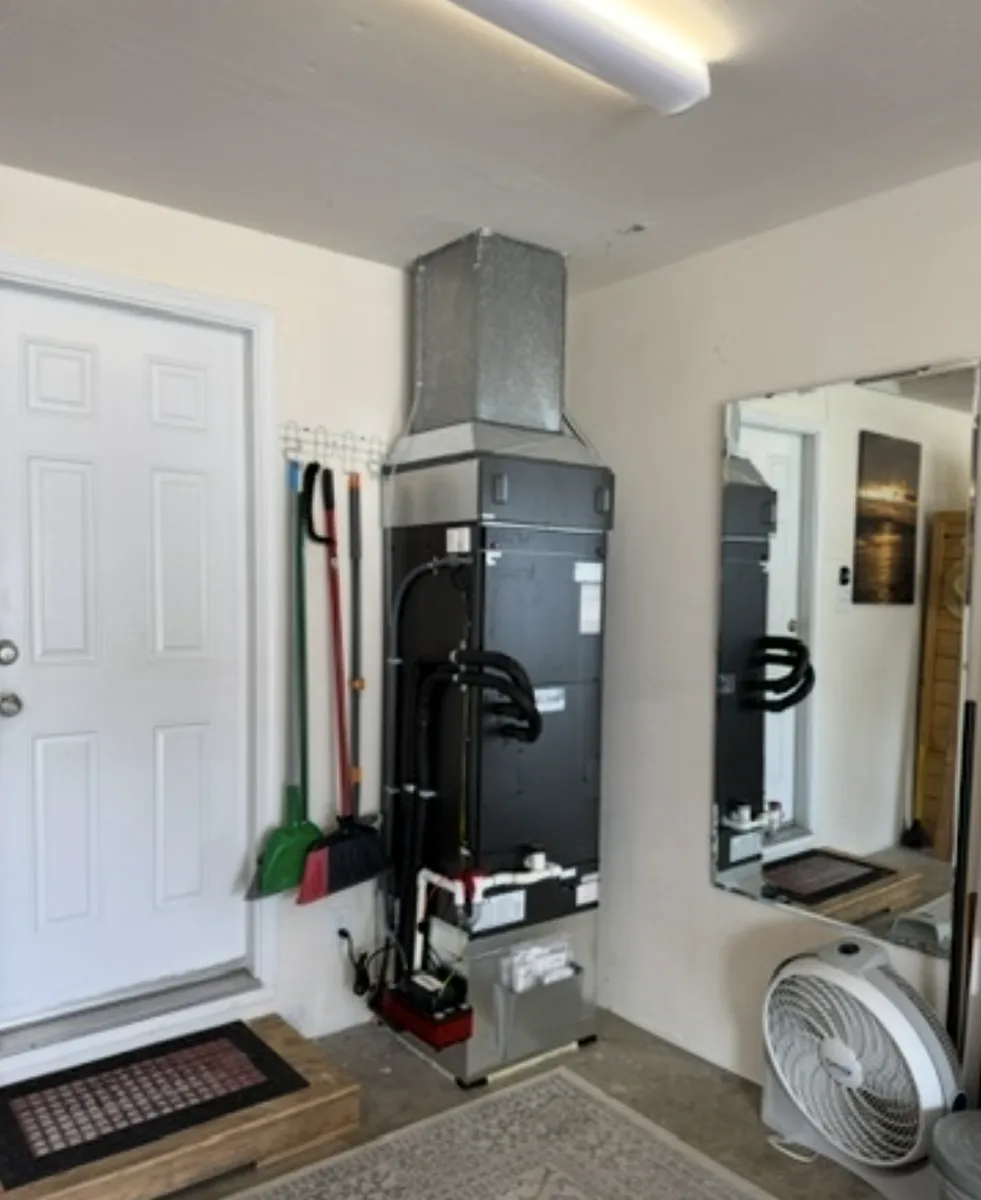
AC repair: what usually failed
Cooling fails in a heat wave, which is when it is under load and when everyone else's is failing too. The common causes are a short list.
A run capacitor weakens and the compressor or the fan hums but will not start — the single most frequent call and one of the cheapest fixes. Contactor points burn and pit. Refrigerant is low, which is never normal wear: refrigerant does not get used up, so low charge means there is a leak, and adding gas without finding the leak is selling you the same repair again next summer. An evaporator coil freezes into a block of ice, which is nearly always restricted airflow — a filter, a closed-off return, or a failing blower — rather than a fault in the cooling equipment itself. A condensate drain blocks and either trips a safety switch or, worse, quietly overflows into the ceiling.
Same routine as everything else here: find what failed, show it to you, price the repair against the replacement, and let you decide. If the unit is old enough to be on a phased-out refrigerant, that goes into the maths honestly rather than being used as a lever.
Maintenance that prevents the breakdown
Most mid-summer AC failures trace back to skipped maintenance. An annual tune-up — ideally in spring before you need cooling — keeps your system efficient and catches small problems before they become expensive ones. Our maintenance visit includes cleaning the condenser coil, checking refrigerant charge, testing electrical components, clearing the condensate line, and verifying airflow across the system.
Regular service also protects your manufacturer warranty, which often requires documented annual maintenance to stay valid. Ask us about a maintenance plan that bundles seasonal visits and priority scheduling.
What our customers say
- ★★★★★
“I honestly can’t say enough good things about this company. From the very first conversation, I felt like we were dealing with people we could genuinely trust — and that alone is huge when it comes to HVAC and plumbing work.”
Paula Allen · Google review
- ★★★★★
“I am extremely satisfied with ExactAir. Most other companies have expensive quotes and used high pressure sales tactics. Rylan was able to immediately set himself apart with genuine conversation and upfront expectations and pricing.”
Alex Gebhart · Google review
- ★★★★★
“Over the past couple of weeks we have used ExactAir for both an emergency call out as well as a new furnace installation. My wife and I were very impressed with the way Rylan communicated with us as well as his technical knowledge and skill.”
Geoff Parkins · Google review
Air Conditioning FAQs
It depends on whether you already have a forced-air furnace. If you do, the usual job is adding an evaporator coil and an outdoor condenser to the ducts you already have, and doing it during a furnace install is the most affordable way to add cooling. A full system on its own costs more, and how much more is decided by size, efficiency tier, the electrical, and whether the ductwork needs work. After a free in-home load calculation you get fixed good/better/best pricing in writing.
If both are near the end, yes, and it is usually cheaper than doing them two years apart — the plenum, the transitions, the electrical and the labour of being on site are paid for once instead of twice. If only one of them is failing, replacing the healthy one to match is a sale, not a recommendation, and you will be told so. Whichever way it goes, both sets of numbers go on the quote.
Increasingly, yes. Recent summers have brought multi-day heat events with temperatures in the 90s. A right-sized system protects comfort, sleep, and family members with asthma or heat sensitivity, and modern heat pumps cool in summer and heat in winter.
A straightforward replacement is usually completed in a single day. New systems that require ductwork or electrical upgrades may take a second day, which we schedule in advance.
We always diagnose first and repair when it makes financial sense. If your unit is older, using phased-out refrigerant, or facing a major component failure, we will show you the math on repair versus replacement and let you decide.
Once a year, ideally in spring. Annual maintenance keeps efficiency high, prevents most summer breakdowns, and is often required to keep your manufacturer warranty valid.
We can walk you through available financing options so a new system fits your monthly budget. Ask during your consultation.
Air Conditioning across our service area
We provide air conditioning throughout Snohomish and King counties. Find your town:
Areas we serve for air conditioning
Everett and the towns around it, south into King County and across to the Eastside. Each area page covers what that town's houses actually need — and who is turning up, which is the same person every time.
Ready to upgrade your home comfort?
Honest pricing, straight answers, and no high-pressure sales. Get your free quote from Rylan, the owner — the person who quotes your job is the person who installs it — plus a 5% discount for military, veterans & first responders.